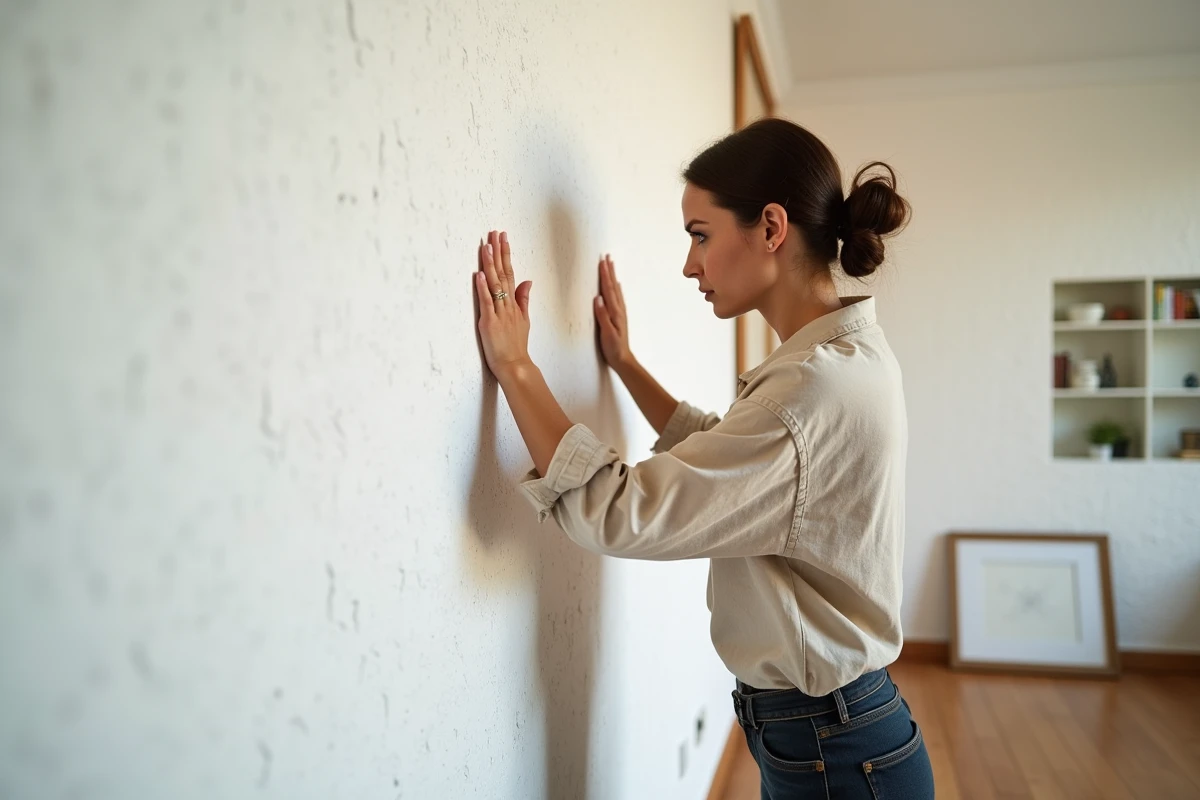
Hanging a frame, a mirror, or a lightweight shelf on a roughcast wall without pulling out the drill is the puzzle for any tenant or homeowner keen on preserving their walls. The roughcast presents a specific problem: its uneven surface reduces the contact area with any adhesive or fastening system. As a result, what holds perfectly on a smooth wall often ends up falling within a few weeks on roughcast.
Why traditional fixings fail on roughcast
Before looking for the right solution, it’s important to understand why the wrong ones don’t work. A roughcast has hollows and bumps of several millimeters. When you apply an adhesive strip or a sticky hook, only the peaks of the reliefs come into contact with the sticky surface.
The actual adhesion surface then represents a fraction of what it would be on a flat wall. The fixing holds for a few days, then the weight of the object creates a gradual shear that detaches the adhesive. Everyday vibrations (slamming doors, drafts) accelerate the process.
Humidity further exacerbates the situation. In a bathroom or kitchen, adhesive strips lose their grip after a few months, even on fine roughcast. Manufacturers actually recommend regularly replacing these fixings, a detail missing from most guides that present these products as permanent solutions.
To successfully hang without drilling on roughcast, you need to compensate for this lack of contact. Two approaches work: filling the reliefs with a soft material, or circumventing the problem by creating a flat intermediate surface.

Polymer sealant on roughcast: the most reliable fixing without drilling
You may have noticed that tilers use thick adhesives to correct the imperfections of a wall? The principle is the same here, on a smaller scale. A polymer-based sealant (like MS polymer or polyurethane) deforms to conform to the reliefs of the roughcast before hardening.
The polymer sealant fills the hollows of the roughcast and multiplies the contact surface. This is what distinguishes it from a flat adhesive that only touches the peaks. For a frame or a small mirror, this solution offers significantly better hold than strips or sticky hooks.
How to apply sealant on roughcast
- Clean the area with a dry brush to remove dust embedded in the hollows of the roughcast. A dirty roughcast prevents any proper adhesion.
- Apply the sealant in a thick bead (not in dots) on the back of the object or the fixing support. The bead should be generous enough to fill the reliefs.
- Press the object firmly against the wall for several seconds, then hold it with masking tape while it dries completely, which usually takes overnight.
- Wait for complete hardening before loading the object. Hanging a heavy frame on still-soft sealant guarantees failure.
Be cautious with removal: the polymer sealant can pull off pieces of roughcast if you ever need to detach it. For a tenant, this method is suitable for less visible locations or items you don’t plan to move before the end of the lease.
Mixed systems on roughcast walls: the pros’ method for medium loads
Experienced DIYers and decorators increasingly favor a hybrid approach on interior roughcast. The principle: install a flat intermediate surface before fixing the object on top.
Specifically, this involves gluing a thin strip of wood, a medium board, or a small batten against the wall with polymer sealant. Once this wedge is securely fixed, you can use any classic system on top (adhesive hook, Velcro, light screws in the wood).
This micro-mechanical shimming compensates for the reliefs of the roughcast and creates a stable support for medium-sized frames or mirrors. Adhesive fixings that would have slipped directly on the roughcast hold properly on this smooth intermediate surface.
Decorative profiles and glued rails
A more elegant variant exists: decorative profiles or glued rails. A horizontal rail fixed with sealant allows you to hang several frames or objects. This solution distributes the weight over a large length of wall, reducing the stress at each contact point.
For an entire room, a glued picture rail transforms a roughcast wall into a modular gallery. You can change the arrangement of frames without touching the wall.
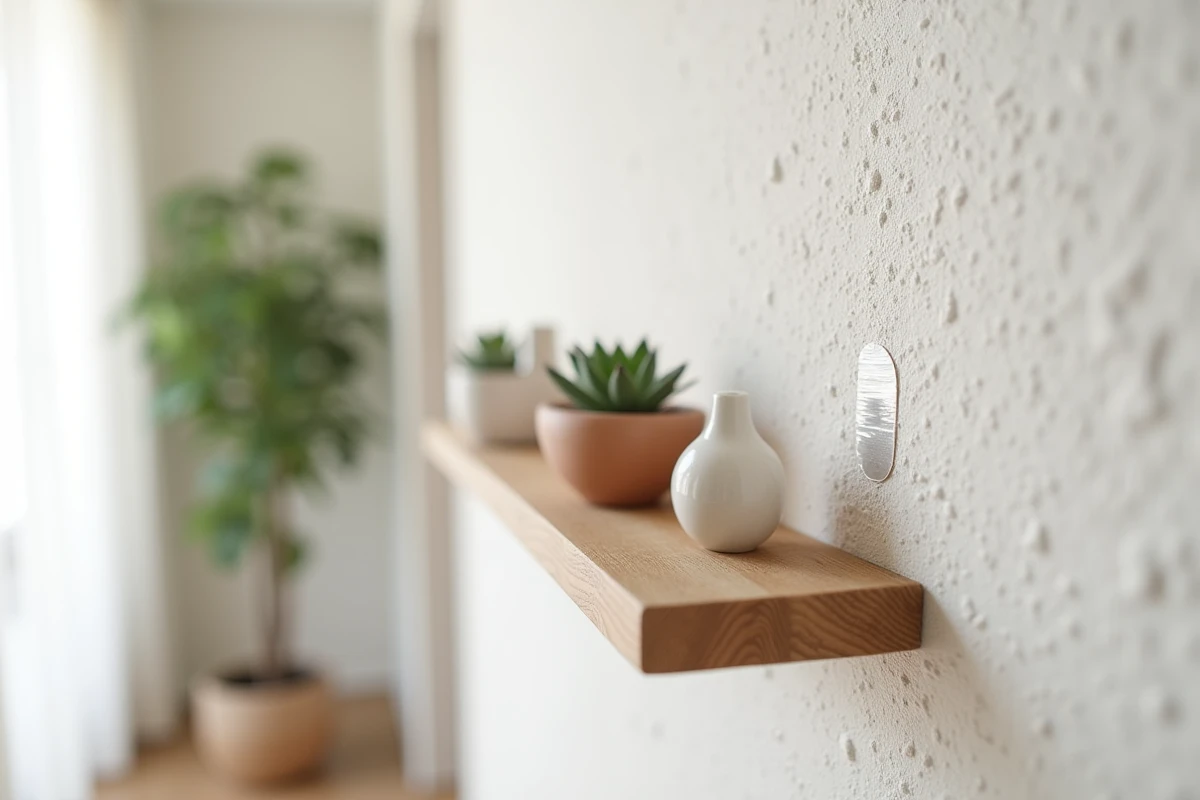
Double-sided adhesives and strips on roughcast: real limits
Adhesive strips like Command or thick foam double-sided tape remain the best-selling products for fixing without drilling. On roughcast, their effectiveness depends on two factors: the grain of the roughcast and the weight of the object.
On fine roughcast (grain of less than one millimeter), thick foam double-sided tape may work for very light objects. The foam partially compresses into the hollows and provides acceptable contact. On coarse roughcast, these adhesives do not hold beyond a few weeks.
The other trap concerns duration. Even when the fixing seems solid at first, the hold deteriorates over time, especially in humid rooms. An object that doesn’t move for three months may fall in the fourth, simply because the adhesive has lost its elasticity.
- Reserve adhesive strips for lightweight objects on fine roughcast only.
- Plan to replace fixings every six months to a year to maintain hold.
- Never use them in a bathroom or kitchen where humidity is frequent.
Fixing without drilling and inventory in rentals
For a tenant, the question goes beyond the hold of the fixing. A piece of roughcast torn off during removal can be deducted from the security deposit. Strong glues and polymer sealants, effective for hold, pose this risk at the time of departure.
The so-called “no trace” strips are designed to be removed cleanly, but their extraction tab works on smooth surfaces. On roughcast, stretching can catch on the roughness and pull off fragments of the coating.
The least risky solution in rentals remains the mixed system with an intermediate panel glued in a discreet location, or decorative profiles that are easier to remove than a direct glue point. Always test the removal on a hidden area before engaging a visible fixing.