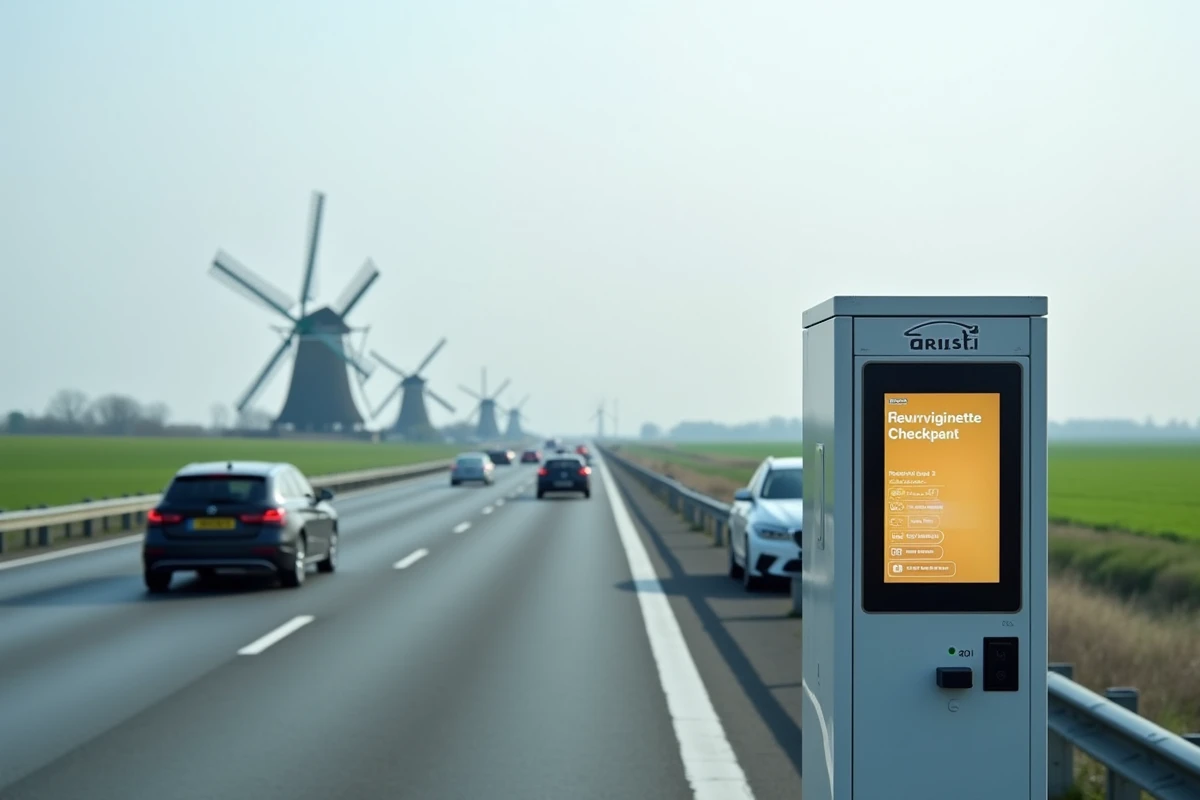
All utility vehicles of 12 tons or more operating on Dutch highways must have a valid eurovignette. This road usage fee, shared with Luxembourg and Sweden, functions as a prepaid toll with rates varying according to the emission class and the number of axles of the vehicle. Cars, vans, and light commercial vehicles are exempt.
Kilometer Tax in the Netherlands: The Planned End of the Eurovignette in 2026
The information that most toll guides still omit: the eurovignette will no longer be required in the Netherlands starting July 1, 2026. According to Viapass, the official Belgian body responsible for the kilometer charge, the eurovignette for the Netherlands ends on June 30, 2026.
The current system will be replaced by a national kilometer tax targeting heavy vehicles over 3.5 tons. This threshold is significantly lower than the current 12 tons, greatly expanding the range of affected vehicles.
The logic is also fundamentally changing. The eurovignette charges a flat fee (daily, weekly, monthly, or annually) regardless of the distance traveled. The future charge will apply the principle of polluter pays: the lighter and less polluting the vehicle, the lower the kilometer tax. Dutch carriers are already anticipating this transition by installing 4G telematics devices compatible with the new system.
To understand the current obligations regarding registration and eurovignette for operating in the Netherlands, it is necessary to distinguish between two periods: before and after July 1, 2026.
Registration of the Eurovignette: Affected Vehicles and Emission Classes
In the current system, the eurovignette applies to utility vehicles and vehicle combinations with a gross vehicle weight of 12 tons or more. Buses are excluded, as are passenger transport vehicles.
Registration is done online at the official portal eurovignettes.eu. The process relies on the vehicle’s license plate and requires several technical details:
- The number of axles of the vehicle or combination (truck plus trailer), which directly influences the applicable rate
- The Euro emission class of the engine (from Euro 0 to Euro VI), which is crucial for calculating the amount, with the most polluting vehicles paying more
- The desired duration for the vignette: daily, weekly, monthly, or annually, depending on the carrier’s traffic profile
The eurovignette is entirely electronic. No physical sticker is affixed to the windshield. Control is carried out by automatic reading of the license plate, making any attempt at fraud easily detectable.
Change in the Pricing Structure from January 2025
The FNTR (National Federation of Road Transport) has reported a change in the eurovignette structure in the Netherlands on January 1, 2025. This pricing revision has increased the price gap between Euro VI vehicles (the least polluting) and lower emission classes, enhancing the incentive to modernize fleets.
Dutch Low Emission Zones: A Distinct Obligation from the Eurovignette
The eurovignette covers access to highways and expressways. The low emission zones (milieuzones) constitute separate regulations, managed by each Dutch municipality. Confusing the two may result in fines.
Several major Dutch cities restrict access to their centers for older diesel vehicles. These restrictions also apply to foreign vehicles. A truck with a valid eurovignette may be denied entry to an urban area if its emission class does not meet the local threshold.

For utility vehicles, the minimum standard required in these zones is generally Euro VI. Diesel cars and vans are subject to varying criteria depending on the municipality. Before planning a route that includes deliveries in the city center, checking the specific regulations of each municipality crossed remains the only reliable precaution.
Transition to Satellite Tolling: What Changes for Foreign Carriers
The shift to the kilometer charge scheduled for July 1, 2026, profoundly alters the logic of access to the Dutch road network. Two points deserve particular attention for foreign fleets.
The threshold drops from 12 tons to 3.5 tons of gross vehicle weight. Thousands of light utility vehicles that have never needed a eurovignette will have to register in the new system. Delivery and service companies using vans above this threshold are directly affected.
The calculation is based on the actual kilometers traveled on the Dutch network. A carrier passing through the Netherlands over a short distance will pay proportionally less than with a daily eurovignette fee. Conversely, a vehicle making many daily trips could see its bill increase.
- Toll service providers (like those already active for the eurovignette) will offer solutions compatible with the new satellite system
- An onboard unit or software solution will be necessary to record the kilometers traveled
- The pricing modulation will take into account the emission class, favoring the least polluting vehicles and those with zero emissions
Carriers who regularly operate in the Netherlands should anticipate this transition now, particularly by checking the compatibility of their existing telematics equipment. The eurovignette remains mandatory until June 30, 2026, and any operation without a valid vignette before this date is subject to penalties.