
The term Wi-Fi Legacy refers to wireless standards prior to Wi-Fi 4 (802.11n), mainly the 802.11a, 802.11b, and 802.11g standards. These protocols, ratified between 1999 and 2003, are still present in many home and professional networks. Measuring the gap between these old standards and current generations helps to understand why their persistence raises concrete questions about throughput, security, and compatibility.
Throughput and Frequency: Comparison of Legacy Wi-Fi Standards Against Recent Standards
The differences between legacy Wi-Fi standards and modern standards are first reflected in the raw technical specifications. The table below summarizes the gaps based on criteria that affect daily network experience.
| Standard | Name | Frequency | Max Theoretical Throughput | Year |
|---|---|---|---|---|
| 802.11b | Wi-Fi 1 | 2.4 GHz | 11 Mbit/s | 1999 |
| 802.11a | Wi-Fi 2 | 5 GHz | 54 Mbit/s | 1999 |
| 802.11g | Wi-Fi 3 | 2.4 GHz | 54 Mbit/s | 2003 |
| 802.11n | Wi-Fi 4 | 2.4 / 5 GHz | 600 Mbit/s | 2009 |
| 802.11ac | Wi-Fi 5 | 5 GHz | 6.9 Gbit/s | 2013 |
| 802.11ax | Wi-Fi 6 / 6E | 2.4 / 5 / 6 GHz | 9.6 Gbit/s | 2020 |
| 802.11be | Wi-Fi 7 | 2.4 / 5 / 6 GHz | 46 Gbit/s | 2024 |
The throughput gap between 802.11b and Wi-Fi 7 represents several orders of magnitude. To understand what legacy Wi-Fi means, it is important to keep in mind that these old protocols operate exclusively on the 2.4 GHz band (with the exception of 802.11a, which is confined to 5 GHz but was very little deployed in Europe at the time).
The 2.4 GHz band used by legacy Wi-Fi has only three non-overlapping channels. In a building or an open space, this limitation causes interference between neighboring access points and with other devices (Bluetooth, microwaves, cordless phones). Recent standards, by utilizing the 5 GHz and 6 GHz bands, have dozens of additional channels and much more generous bandwidths.

Network Security: The Structural Flaws of Legacy Wi-Fi
The WEP encryption protocol, associated with the early 802.11b/g standards, was publicly broken as early as the early 2000s. Its successor WPA (TKIP) fixed the most blatant flaws, but also had exploitable vulnerabilities.
WEP and first-generation WPA no longer protect a network. Tools to intercept traffic on these protocols are freely available and documented. A legacy device that only supports WEP or WPA-TKIP forces the router to lower the encryption level of the entire network or requires the administrator to create a dedicated SSID with a lower security level.
ANSSI explicitly recommends, in version 2.0 of its IT hygiene guide (2023), to segment and isolate legacy Wi-Fi networks from production networks. The reason: it is often impossible to correct old implementations with a simple software update. The hardware itself does not support modern encryption algorithms (WPA3, AES-256).
- Isolate the legacy network on a dedicated VLAN, with strict firewall rules limiting access to only necessary resources
- Disable WEP and WPA-TKIP protocols on the main network to prevent any connection negotiation on a weak standard
- Plan the replacement of legacy devices according to a realistic schedule, prioritizing those that handle sensitive data
Industrial Uses: Why Legacy Wi-Fi Persists in Warehouses
In industrial environments, replacing legacy Wi-Fi is not simply a technical choice. Zebra Technologies further specifies in its 2024 deployment guides for rugged terminals that support for 802.11b/g must remain enabled in certain warehouses to ensure interoperability with fleets of older automation devices, scanners, and connected carts.
The cost of simultaneously replacing hundreds of rugged terminals, which often have a lifespan exceeding ten years, hinders migration. An industrial scanner that can only operate on 802.11g cannot receive a hardware update to support 802.11ax.
The coexistence of legacy devices and newer devices on the same access point generates a measurable phenomenon: a single 802.11b client slows down all other devices on the network. The router must indeed reserve antenna time to communicate at low speed with the legacy client, reducing the available bandwidth for fast connections. This protection mechanism, inherited from the standard, penalizes the entire network.
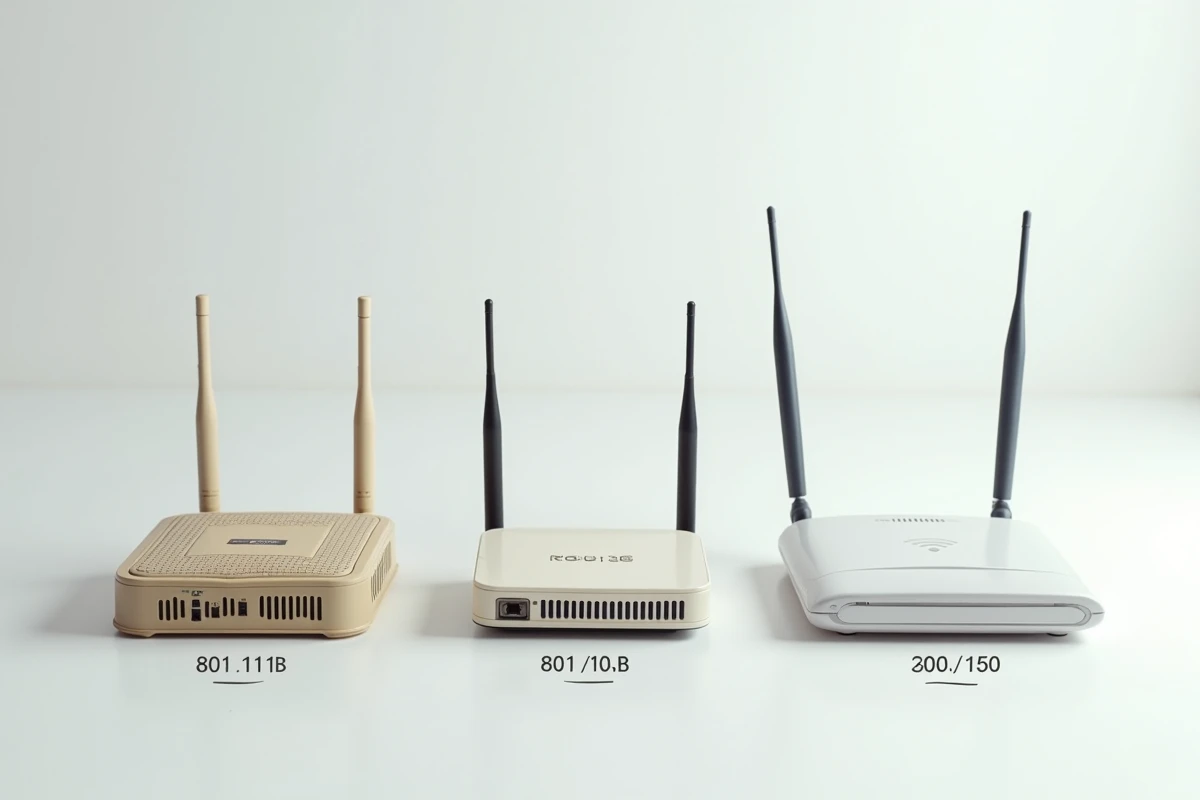
Trade-off Between Backward Compatibility and Performance
Disabling 802.11b support on an access point immediately frees up antenna time. However, this operation makes all legacy devices on the network invisible. The decision depends on the actual inventory of connected equipment.
- Conduct a Wi-Fi audit to precisely identify devices that still negotiate in 802.11b or 802.11g
- Switch access points to “802.11g minimum” mode to eliminate 802.11b while maintaining compatibility with 802.11g devices
- Deploy access points dedicated to the legacy fleet, physically separated from the main network, to avoid penalizing modern connections
- Document each exception to anticipate replacements during the next budget cycle
Migration from Legacy Wi-Fi: Decision Criteria for a Mixed Network
The question is not whether legacy Wi-Fi will disappear, but at what pace each organization can absorb the cost of the transition. Three criteria guide the decision: the sensitivity of the data transmitted over the network, the density of devices connected simultaneously, and the remaining lifespan of the hardware fleet.
A home network with an old printer connected via 802.11g does not present the same level of risk as a logistics warehouse processing real-time order data. The first case is often resolved with an Ethernet cable. The second requires planning over several months, with regression testing on each automation device.
The 5 GHz and 6 GHz frequency bands offer more channels and throughput, but their range remains lower than that of 2.4 GHz. In a large building, the legacy coverage in 2.4 GHz reaches areas that 5 GHz does not cover without additional access points. This physical parameter partly explains the longevity of 2.4 GHz in large-scale deployments.
The persistence of legacy Wi-Fi in current infrastructures reflects a constant trade-off between compatibility and performance. ANSSI’s recommendations and the practices of industrial integrators converge on one point: isolate rather than eliminate as long as the fleet is not renewed. The complete disappearance of the 802.11b/g standards will depend less on the available technical capabilities than on the pace of renewal of the oldest equipment.