
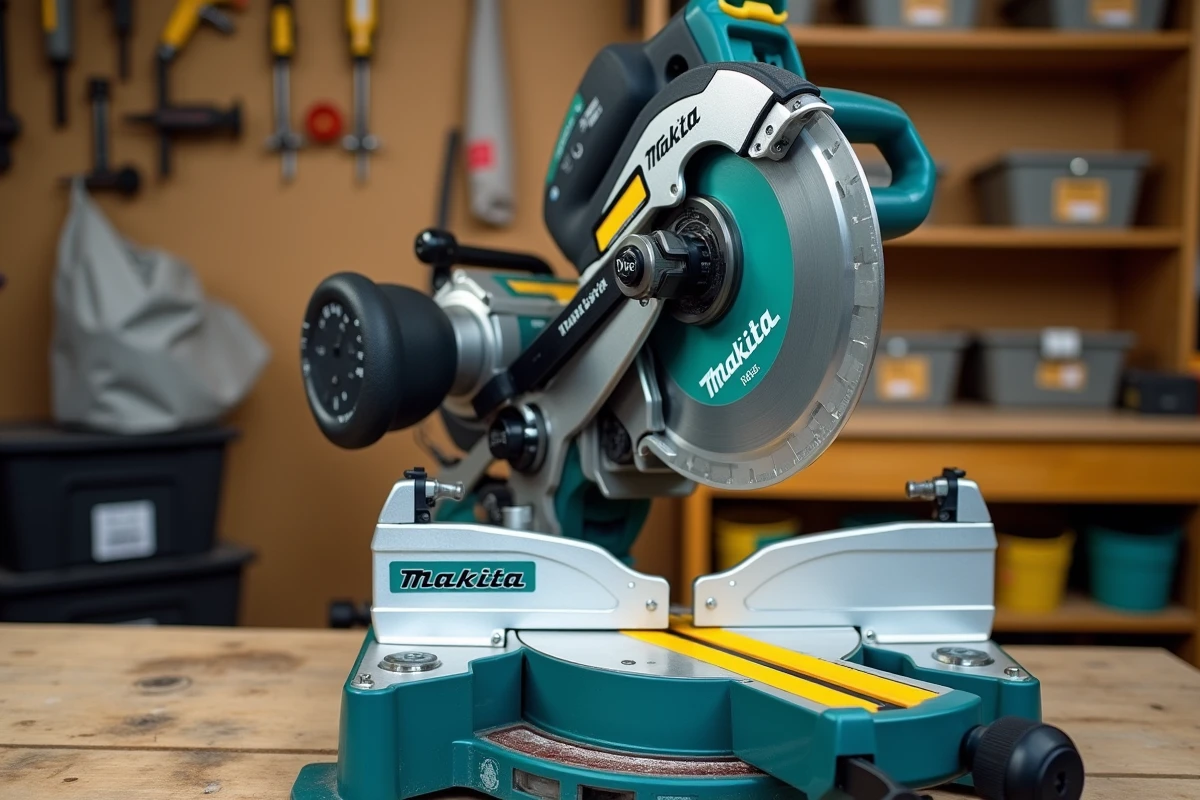
The Makita LS1018L is a sliding compound miter saw equipped with a 260 mm blade and standard guide rails. This format places it in a specific category: machines capable of cutting baseboards, frames, and medium-width panels, while remaining transportable on site.
Sliding Rail System and Size of the Makita LS1018L
The first point that distinguishes the LS1018L from newer models is the design of its slides. The sliding rails extend from the back of the machine when pulling the cutting head towards you. This design has a direct consequence: the saw needs space behind it to operate.
On a workbench against the wall, this constraint can become inconvenient. You need to allow an additional twenty centimeters of clearance compared to a saw with offset sliding rails (like the LS1019L, which folds its rails forward).
On the other hand, the overall depth of the machine remains contained. Several carpenters working in interior renovation mention that the LS1018L fits better in a compact van than larger models with offset sliding rails. For mobile workshop use, reviews of the Makita LS1018L confirm this transport advantage.
Actual Cutting Capacity on Baseboards and Frames
The cutting capacity of a radial saw is measured in width and height at 90°, then at a 45° angle. On the LS1018L, the cutting width at 90° allows for most standard baseboards and common door frames.
Where the machine shows its limits is with wide materials. Shelf boards or tall baseboards (beyond the maximum capacity) require either flipping the piece or a larger format saw. This constraint is rarely highlighted in commercial presentations.
Combined Miter and Bevel Cuts
The table pivots for miter cuts, and the head tilts for bevels. Combined miter + bevel cuts remain precise as long as the plate clamp is securely locked. The original workpiece clamping device does the job on common wood sections, but it deserves to be supplemented with an additional vise as soon as you tackle aluminum or thin profiles that vibrate.
Laser of the LS1018L: Reliability and Alternatives
The LS1018L features a guiding laser intended to project the cutting line onto the piece. On paper, this is an asset for repetitive cuts. In practice, it is the most documented weak point of this machine.
The consolidated customer service feedback from Makita for the period 2022-2024 shows that the majority of reported incidents concern the laser: gradual misalignment or outright failure. The motor and mechanical precision of the saw, however, remain in the lower range of return rates for the brand’s 260 mm radial saws.
- The laser shifts after a few months of intensive use, requiring regular recalibration or forgoing it altogether
- Some users disable the laser and work with a pencil line or low-angle LED lighting, which is more reliable for spotting the blade line
- The laser module can be replaced through customer service, but the cost of the part and labor diminishes the appeal compared to a manual marking method
This flaw does not affect the quality of the cut itself. The mechanical precision of the LS1018L does not depend on the laser, which remains a visual comfort accessory.

Dust Collection: A Point to Anticipate Before Purchase
The LS1018L is one of the few models in its category still delivered without an optimized dust collection system. No dual extraction, no redesigned nozzle. The original bag captures a fraction of the sawdust, while the rest disperses around the machine.
For outdoor or job site use, this is not a major issue. For a closed workshop, especially if cleanliness requirements apply (cohabitation with other machines, shared space), the saw must be connected to a workshop vacuum from day one.
Adapting an External Dust Extraction System
The rear nozzle accepts a standard connection to a vacuum. The gain is significant: most fine dust is captured before dispersing. Some users create an additional plywood hood to channel projections toward the extraction point, a simple modification that transforms the comfort of use.
Makita LS1018L vs. LS1019L: What Really Changes
The question consistently arises in specialized forums. The LS1019L, a newer model, stands out mainly for its compact sliding rail system that does not require rear clearance, and for a slightly higher cutting capacity.
- The LS1019L takes up less space in depth, making it easier to position against a workshop wall
- The LS1018L maintains a slightly lower weight and overall size, advantageous for transport
- Both machines share the same type of motor and the same cutting quality on common materials (solid wood, MDF, thin aluminum)
- The LS1019L is reported as discontinued in some countries, complicating the supply of spare parts depending on the markets
The choice between the two depends on the available space and the frequency of transport. A fixed workshop with little rear clearance favors the LS1019L. A mobile use, with frequent loading into a vehicle, leans towards the LS1018L.
The LS1018L remains offered by many retailers despite the arrival of its successor, precisely because its mechanical reliability is well established and the only recurring weak point (the laser) does not affect the cut. For those willing to work without laser guidance or to recalibrate it periodically, this sliding radial saw continues to fulfill its role with a precision that its price makes hard to contest.