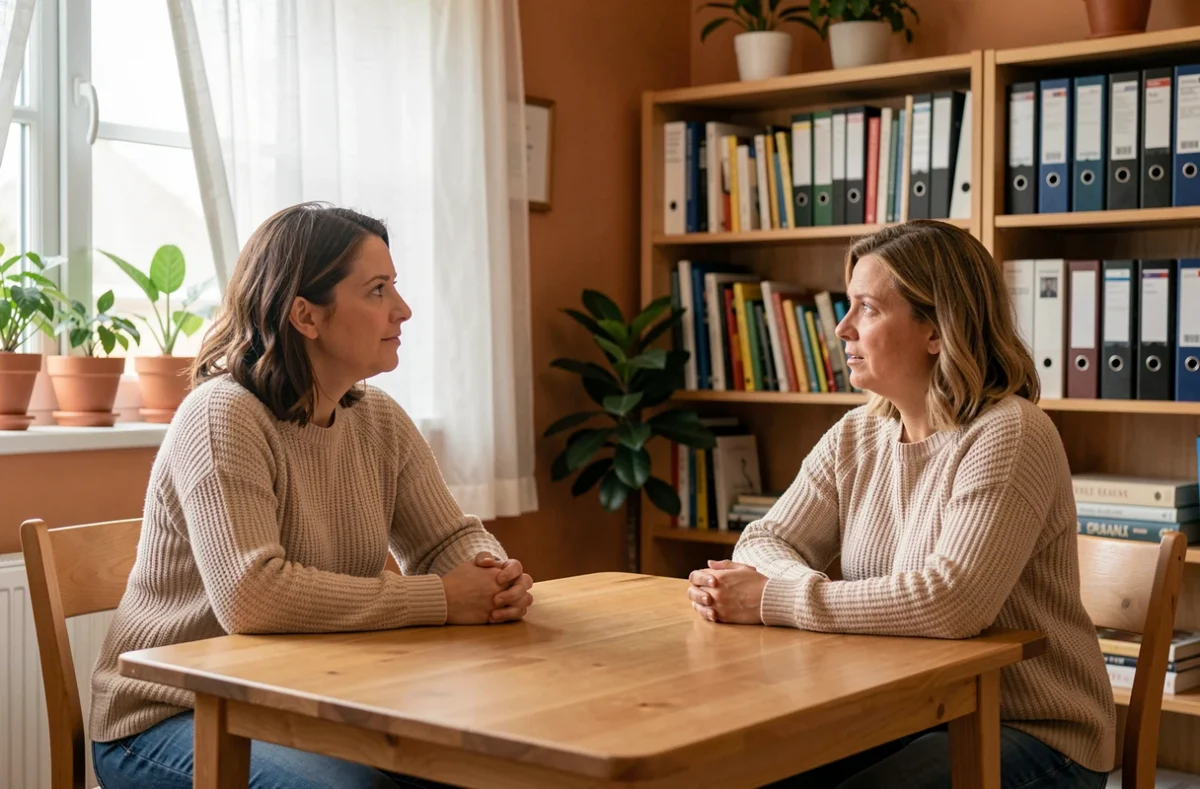
A women’s center is a facility that brings together, under one roof or within the same network, services for listening, legal support, psychological assistance, and social guidance aimed at women facing vulnerable situations. These centers are not limited to crisis management: they intervene before, during, and after difficulties, with the goal of sustainable autonomy.
Comprehensive support in women’s centers: beyond just a helpline
Most visible online services highlight a helpline or an emergency number. This initial contact is useful, but it represents only a fraction of what a structured center offers. Real support often begins after this first call, when it is necessary to coordinate multiple types of assistance simultaneously.
A women’s center typically encompasses three components. The psychological component offers individual interviews with professionals trained in domestic violence and psychological manipulation. The legal component helps women understand their rights, prepare a case, or be referred to a lawyer. The social component addresses issues related to housing, access to benefits, and professional reintegration.
What distinguishes a center from a simple drop-in service is the coordination between these services. A woman does not have to repeat her story to each contact: the teams share a common follow-up, respecting confidentiality. On the main page of Centre de Femmes Entrelles, this logic of integrated support is detailed along with the various accessible resources.

Emergency legal protection: mechanisms available to victims of violence
Women victims of violence have legal mechanisms that can be activated quickly, sometimes even before filing a formal complaint. The law of June 13, 2024, created the provisional immediate protection order: a judge can rule without a hearing within 24 hours when violence and a serious and immediate danger seem likely.
This mechanism does not replace the traditional protection order, but it allows for security measures to be taken while awaiting its review. Women’s centers play a concrete role in this procedure: they help gather the necessary elements for the request and direct women to the appropriate legal professionals.
What a protection order covers
The protection order is not limited to prohibiting contact. It can also address aspects that directly affect the reconstruction of daily life.
- Granting the marital home to the victim, even if she is not the owner, to avoid a situation of homelessness
- Measures related to the exercise of parental authority and contribution to household expenses, thus protecting the financial autonomy of the victim
- Granting custody of the pet, a point mentioned by recent legal sources and often used as leverage by the perpetrator of the violence
The centers assist women in understanding these mechanisms. Knowing the extent of one’s rights changes the way one approaches a dangerous situation.
Local network and coordination between associations and public services
A women’s center does not operate in isolation. Its effectiveness relies on its integration into a local network of partners: hospital services, law enforcement, departmental social services, social landlords, and other specialized associations.
The Alba service, supported by the Atherbea association and presented by the City of Bayonne, illustrates this logic. Described as a support mechanism towards autonomy, it animates the local network for supporting women victims of violence in the Basque Country. This type of coordination helps avoid disruptions in the journey when a woman transitions from emergency services to medium-term support.
Why coordination changes the support journey
Without a structured network, a woman leaving emergency accommodation may find herself without psychological follow-up or legal support. Continuity between mechanisms reduces the risk of returning to a violent environment. Centers that actively participate in these local networks ensure a relay between each step of the journey.
Associations affiliated with the National Federation for Women’s Solidarity or the Federation of Solidarity Actors benefit from a shared methodological framework. This affiliation with national federations guarantees ongoing training for teams and harmonization of reception practices.
Volunteer listening and professional support: two complementary approaches
Women’s centers mobilize both qualified employees (psychologists, lawyers, social workers) and trained volunteers in active listening. These two profiles do not serve the same function, and their complementarity is an asset.
Volunteers often handle the phone lines and initial receptions. Their training, mandatory in serious organizations, focuses on the framework of confidentiality and empathetic listening techniques. Their role is to provide a non-judgmental space for expression and to guide individuals to the appropriate professionals.
Professionals intervene in areas that require technical expertise: assessing danger, assisting with legal proceedings, and providing specialized psychological follow-up in psychotrauma. An effective center knows how to distinguish these two levels of intervention and articulate them without role confusion.
- Volunteer listening provides an accessible first contact, often available during extended hours, including in the evening
- Professional follow-up takes over for complex situations, with structured interviews and a personalized support plan
- Regular supervision of volunteers by professionals ensures the quality of reception and prevents team burnout
Data on violence recorded by the police and gendarmerie only reflect a portion of the actual needs for support. Many women contact a center without having filed a complaint, sometimes months or years after the events. A women’s center responds to this reality by offering unconditional reception, where the first step remains the same: to be heard.