
When managing two babies of the same age, or three children under five, even the smallest logistical detail takes on a new dimension. The equipment to double, the medical appointments piling up, the broken nights: parenting in multiple mode is played out through concrete trade-offs, not general principles. The regulatory changes of 2026, particularly around parental leave, also change the game for large families and parents of twins.
Monochorionic or bichorionic twin pregnancy: very different medical follow-up
We often talk about twin pregnancy as a whole, but the type of placentation radically changes the follow-up process. Monochorionic pregnancies, where twins share a single placenta, require more frequent ultrasounds. The risk of twin-to-twin transfusion syndrome and growth discordance between the two babies justifies this enhanced monitoring, according to the recommendations of the French National College of Gynecologists and Obstetricians.
For bichorionic pregnancies (two distinct placentas), the ultrasound schedule remains regular but less intense. In practical terms, knowing the type of twin pregnancy determines the number of medical appointments and the organization of daily life from the first trimester. This is information to obtain early to anticipate work absences and plan for the support of the partner or family.
Another point that has evolved recently: recommendations tend to avoid systematic cesarean sections for twin pregnancies. When the first twin is in a head-down position and medical conditions allow, a trial of vaginal delivery is now preferred. Feedback on this point varies among maternity wards, but the trend is clear in updated protocols.
We regularly find feedback from the field and testimonials from parents facing these choices in recent articles on mamandouble.fr, which document the journeys of multiple pregnancies over the months.
Additional birth leave 2026: what changes for parents of twins
The new additional birth leave applies to children born or adopted from January 1, 2026. Each parent can take one or two additional months after maternity, paternity, or adoption leave. The announced compensation is 70% of net salary for the first month, then 60% for the second, within the applicable ceiling.
For a family with twins, this provision offers additional flexibility regarding parental presence at home in the early months. Two extra months per parent help cover the critical period of disrupted nights and the establishment of feeding routines.
Impact on daycare spots
This extended leave may, however, disrupt the organization of daycare spots. When the return of children is staggered, facilities find themselves with reserved but unused hours. The Family branch anticipates a temporary financial compensation in 2026 for certain early childhood care facilities to cover this gap.
In practice, we advise notifying the daycare as early as possible if you plan to use this additional leave. A two-month delay for two spots has a real impact on the management of a facility.
Equipment for twins: deciding between doubling and sharing
Not everything needs to be doubled. This is the first reflex to correct when preparing for the arrival of twins or expanding a large family. Here are the most common practical trade-offs:
- Car seats and cribs: one per child is mandatory, with no compromise on safety. For cribs, a single shared bassinet works for the first few weeks, but two separate spaces become necessary as the babies move more.
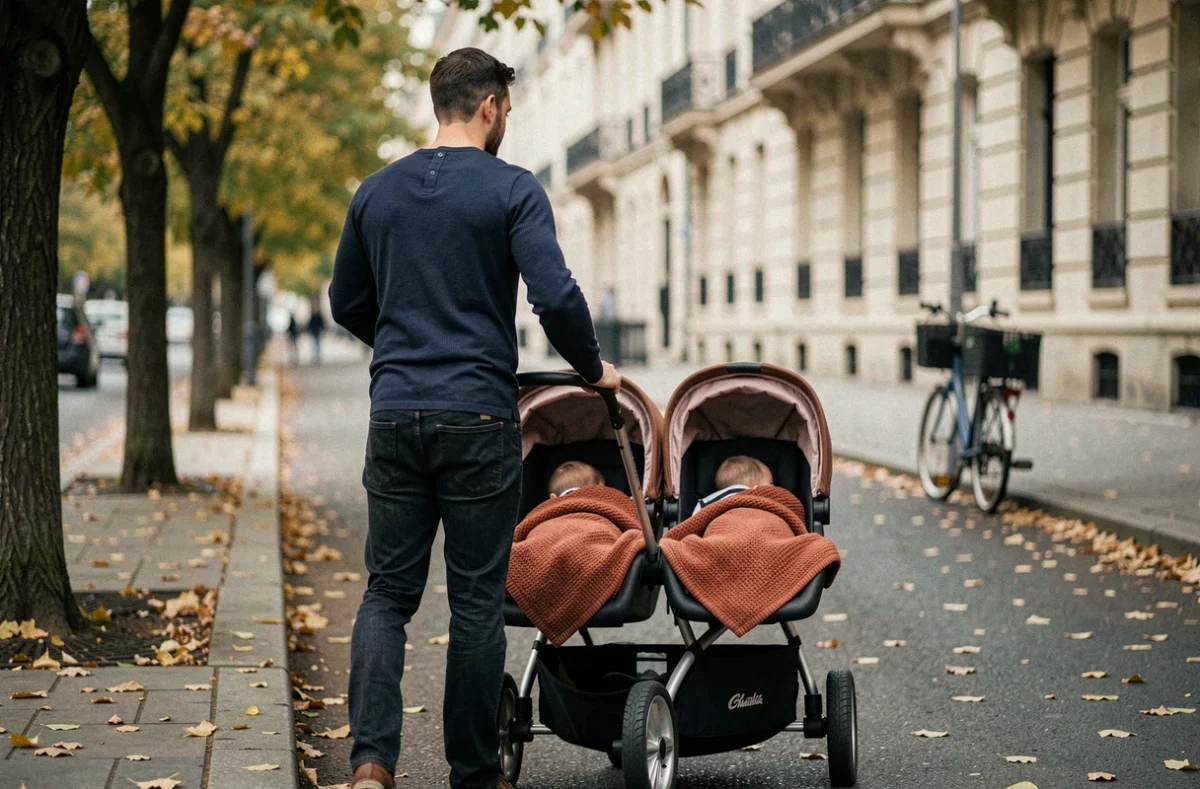
- The double stroller: this is the central investment. Inline models (one child in front of the other) fit through doors better, but side-by-side models offer better visibility of both children. The choice depends on your living situation and daily routes.
- Feeding equipment: two high chairs are not immediately necessary, a bouncer and a chair are sufficient at first. However, a double bottle warmer saves real time at night.
- Clothing: share as much as possible between the two children, without trying to coordinate systematically. Identical packs of bodysuits in various sizes remain the most economical choice.

Large family: educational choices that weigh on daily life
With three children or more, the question is not to find the perfect educational method, but to maintain a consistent approach when the needs of each child diverge. One twin may have a sleep rhythm that is forty-five minutes off from the other, while an older sibling demands attention for homework.
Synchronizing routines is often presented as the universal solution. However, it turns out that forcing two twins to sleep or eat at the same time generates as much stress as a staggered rhythm. The approach that works best is to synchronize a single fixed reference point each day (the evening bath or lunchtime, for example) and let the rest adjust.
Preserving individual time with each child
In a large family, one-on-one time with each child is mechanically reduced. A few dedicated minutes, even brief, have more impact than a long collective activity on the feeling of emotional security. Ten exclusive minutes are worth more than an hour shared among four when it comes to meeting the need for individual attention.
Parents of twins and large families navigate between material constraints, regulatory changes, and ongoing educational adjustments. The additional birth leave of 2026 provides a concrete lever, but it is in the micro-decisions of daily life, from the type of stroller to the rhythm of meals, that family balance is built.