The KTEL network structures intercity mobility in Crete, but its actual coverage depends on a parameter often underestimated: the seasonal amplitude of secondary lines. From June to September, the main connections between Heraklion, Rethymnon, Chania, and Agios Nikolaos operate at regular intervals. By autumn, some village services run only once or a few times a week.
We recommend planning any car-free itinerary around this calendar constraint before choosing the stops.
Bus-ferry connections on the southwest coast of Crete
The southern coast between Paleochora and Chora Sfakion does not have a continuous coastal road. This section operates as a combined network, where KTEL buses from Chania provide access to the terminals, and ANENDYK coastal ferries connect the villages.
The maritime links connect Paleochora, Sougia, Agia Roumeli, Loutro, and Chora Sfakion. Loutro is only accessible by boat or footpath, making it a mandatory stop for ferries, not a road terminus. Seasonal buses serve Sougia and Sfakia from Chania, but their frequency drops significantly outside of summer.
Specifically, a traveler wanting to connect Paleochora to Chora Sfakion without a car must take an ANENDYK ferry with intermediate stops. The reverse also works. This network allows for building a southwest loop over several days, provided that the last maritime rotation schedules are checked, which dictate the entire return logistics.
For those looking to visit Crete without a car by utilizing this combined network, choosing Paleochora or Chora Sfakion as a base camp makes a significant difference in the number of villages accessible in a day.
Samaria Gorge without a car: the transport chain to anticipate
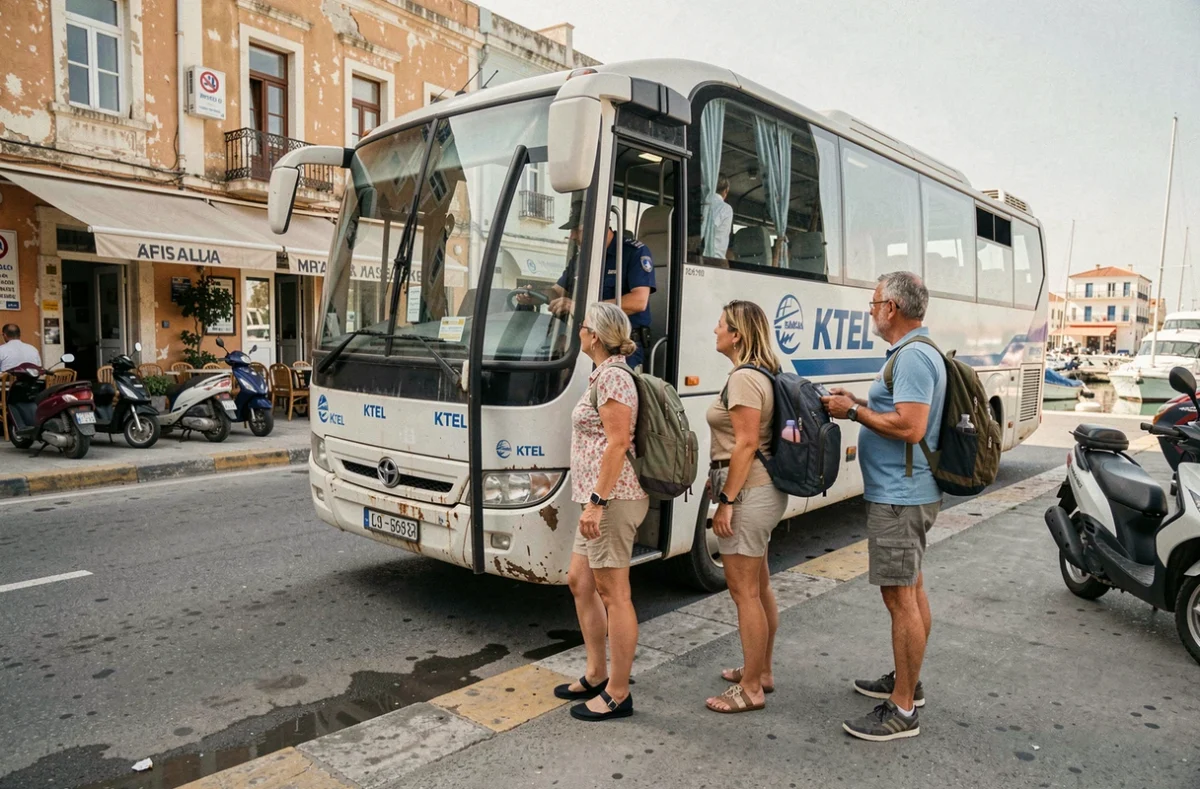
The trek through the Samaria Gorge does not end where it begins. Agia Roumeli, the endpoint, has no direct road connection. The return to Chania requires a precise sequence: ferry to Sougia or Chora Sfakion, then KTEL bus to Chania.
This constraint has several practical consequences:
- Departure must be early in the morning from Chania (bus to Omalos, trailhead) to allow enough time before the last evening ferry at Agia Roumeli.
- The choice of return port (Sougia or Chora Sfakion) depends on the ferry schedule for the day and the available bus connection afterward.
- A delay on the trail or a missed ferry means an overnight stay at Agia Roumeli, a village with limited accommodation capacity in high season.
We observe that many travelers underestimate the total duration of the day. The trek itself takes several hours, but the return journey by ferry and then by bus adds comparable transport time. Checking ANENDYK schedules the day before departure is a non-negotiable step.
North KTEL axis: Heraklion, Rethymnon, Chania, and Agios Nikolaos
The northern road axis concentrates most of the bus traffic in Crete. The Heraklion-Chania connection via Rethymnon forms the backbone of the KTEL network, with sufficient frequencies to travel without planning each trip to the minute. To the east, the Heraklion-Agios Nikolaos line serves the eastern part of the island.
This northern corridor works well for a stay based in one or two cities. Rethymnon offers the most advantageous central position for radiating west (Chania, gorges, southwest coast) and east (Heraklion, archaeological sites).
On the other hand, the secondary lines that descend south from this northern axis quickly lose regularity. Services to villages like Plakias or Matala exist, but with a reduced number of daily rotations. Missing the last evening bus often means finding accommodation on-site or resorting to a taxi, the cost of which rises quickly over these rural distances.
Organized excursions from Heraklion and Chania: what they really cover
Day excursions fill the gaps in the KTEL network for remote or poorly served sites. From Heraklion, the tours cover Knossos, the Lassithi plateau, and Spinalonga. From Chania, the offerings target Elafonissi, Balos, and the Samaria Gorge.
The main interest is not comfort but access. Elafonissi and Balos are very difficult to reach by public transport, especially off-season. The excursions include round-trip transport and solve the issue of the last connection, which remains the major friction point of traveling without a car in Crete.
The compromise lies in flexibility. An excursion bus imposes fixed visiting times, which does not suit hikers or travelers who prefer to adjust their time on-site. For Samaria in particular, organized excursions already integrate the ferry-bus return chain, which eliminates the risk of missing the ferry but leaves less room for walking pace.
A car-free stay in Crete relies on three pillars: the northern KTEL network for intercity travel, ANENDYK ferries for the southwest coast, and excursions for isolated sites. The viability of the whole depends directly on the travel period. Outside the summer season, frequency reductions on secondary lines and maritime connections turn a smooth itinerary into a logistical puzzle.